Women in Science: Four EMBA Alumnae share how they turn Expertise into Executive Influence

27.2.2026

Nowadays, scientific careers sit at the intersection of research, technology, regulation, and global markets, yet women remain less visible at senior executive levels. The challenge today is not entering scientific fields, but progressing into decision-making roles. Last February, we celebrated the International Day of Women and Girls in Science. On this occasion, we highlight four alumnae of the ESSEC Executive MBA: Houda (ESSEC & Mannheim EMBA ‘26), Valeria and Shirine (ESSEC Weekend EMBA ‘26), and Joane (ESSEC & Mannheim EMBA ‘23). They share how their careers evolved from scientific expertise to leadership responsibility. Across sectors and geographies, their journeys show a common pattern: deep technical knowledge built their credibility and the Executive MBA helped them expand that expertise into strategic influence - enabling innovation to translate into measurable impact.


For our Executive MBA alumnae, choosing science was not a symbolic act. It was an intellectual decision. Their careers began with curiosity - a genuine interest in mathematics, biology, physics, data, or technologies. Their entry into scientific fields was not framed around gender but around the desire to change the world and future for the better.

Shirine, Associate Director of Business Development Europe at Guardant Health, elaborates:

“To me, science is not a matter of gender, but of intellect. I view myself primarily as a ‘brain’ - an engine for understanding and building knowledge for future generations.”

Joane,Global Head of Evidence at Opella, and Valeria,- Life Sciences and Healthcare Senior Expert at Dassault Systèmes, share a similar position - the latter explains:

“In the end, to me, it is less about being a woman or a man, and more about purpose: the reason you wake up in the morning, go to work, and contribute to society through meaningful impact!”

In both cases, expertise comes first. Gender is acknowledged, but it does not define ambition. What defines their trajectory is rigor, consistency, and the intention to contribute meaningfully.

Their sources of inspiration reflect this mindset. For Houda, working as Head of Data & AI, leadership is grounded in resilience:

“My role model is my mother. She is a warrior in the truest sense and a symbol of resilience. She taught me that it is not about resisting once, but about standing up every day.”

Others describe a mosaic of influences: professors, colleagues, family members, and leaders met across countries and sectors. They draw lessons from these encounters and shape their own approach.

Marie Curie stands out as a historical reference point. Shirine describes her as “a lifelong inspiration for her passion and her ability to make major discoveries in physics during an era - and a field - dominated by men.”

Her legacy highlights a lasting reality: women have always contributed to scientific progress, yet this has not always translated into representation in executive roles. Today, those roles shape funding decisions, regulatory positioning, and commercialization strategies. Access to these positions matters for broader representation in strategic decision-making, and our alumnae are part of this shift.
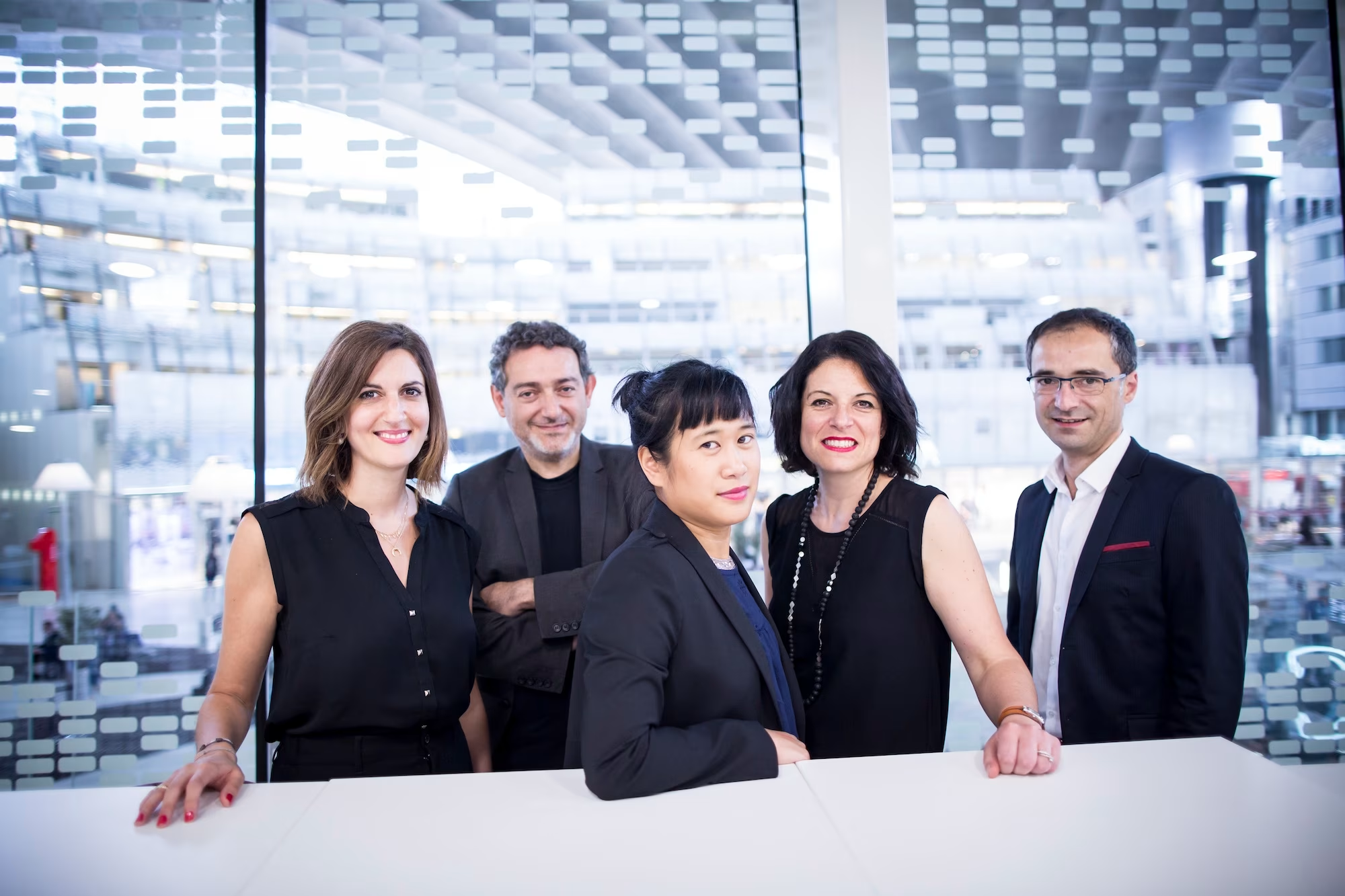

As Houda, Valeria, Shirine and Joane’s careers evolved, new challenges emerged. What began in laboratories or academic institutions expanded into healthcare organizations, biotech companies, digital platforms, and global markets. With this expansion came broader responsibilities: leading teams, aligning stakeholders, and contributing to strategy.

For the four alumnae, this shift marked a structural turning point. Technical expertise remained essential, but it was no longer sufficient. They needed to understand business models, regulatory frameworks, financial constraints, and cross-functional collaboration. Shirine explains:

“I spent a decade in the heart of academic research before transitioning into the commercial healthcare sector. [...] My most significant challenges arose from the structural transition from academia to the corporate biotech world.”

The change was not about leaving science behind. It was about applying it in a different system. In academia, autonomy and depth are central. In corporate biotech, performance depends on coordination across finance, operations, regulatory, and marketing teams. Scientific insight must align with timelines, budgets, and market realities. Joane illustrates this idea:

“My career is a mix of roles in different parts of the world, both at leadership and scientific levels [...] There is no single ‘right’ way to be a scientist or a professional woman. You do not have to fit one mold; you can create your own path by combining the best of what you learn from each environment.”

Progression is not automatic. As Shirine notes, the “broken rung” remains visible between strong expertise and executive authority. Representation at CEO and board level remains limited. Being a woman in science today therefore goes beyond participation. It means contributing diverse perspectives where strategic decisions are made.

Bridging this step requires structured tools - business acumen, strategic thinking, and executive confidence. This is where embarking on an Executive MBA becomes a turning point.

For our alumnae, the Executive MBA accelerated a transition already underway. Houda highlights the 360° vision of business and strategy acquired through her EMBA:

“The Executive MBA sharpened how I lead and decide at scale. It helped me connect AI, strategy, finance, geopolitics, and organizational dynamics into one coherent perspective."

The shift is not about moving away from science. It is about expanding competence, influence and vision and using them to create value. Valeria reflects:

“The EMBA has reinforced my conviction that, beyond gender, what truly matters in leadership is what you believe in, what you are passionate about, and the value you bring to others and to organizations.”

Innovation rarely emerges from isolated expertise. By providing room for collaboration and global perspectives, the Executive MBA serves as a structured environment for innovation. Participants work in Multi-Competency Teams, bringing together professionals from various cultures and backgrounds, while international residencies expose them to different economic and regulatory ecosystems. This diversity expands how leaders frame complex decisions.

Joane emphasizes:

“Innovation rarely happens in silos. The EMBA taught me how to lead cross-functional teams [...] That is crucial in innovation because breakthrough ideas need working together effectively across diverse perspectives to become market realities.”

The impact is tangible. For Shirine, the program’s entrepreneurial approach and support provided the final confidence to launch Nutri&Go!, an entrepreneurial venture she had envisioned for eight years. Leading an all-female team, she applies both scientific and business expertise to build a data-driven wellbeing initiative - an illustration of how structured reflection can convert ambition into execution.

In each case, the EMBA strengthens one capability: the ability to place innovation where it belongs - at the leadership table, where strategic decisions are made.

Across their journeys, our Alumnae share a common vision: expertise is the foundation, but growth is a choice. Houda advises young women to focus on substance:

“Build depth before seeking visibility. Build expertise while understanding the business context. Choose environments that challenge you. Leadership will follow.”

Joane encourages curiosity and courage:

“Do not stop learning, embrace every opportunity, and make sure you are in a place where you feel supported and at home.”

Shirine highlights the balance between guidance and self-growth:

“My primary advice is to actively seek out a mentor [...] You must also be the architect of your own growth.”

On her part, Valeria brings it back to purpose:

“Beyond gender, what truly matters is what you believe in, what you are passionate about, and the value you bring to others.”

Their experiences show that scientific expertise is only the starting point. To shape decisions at executive level, it must be combined with strategic vision and business understanding. The Executive MBA supports this progression - not by replacing scientific depth, but by strengthening it with the tools required to lead across functions, markets, and cultures - while adjusting to the future of an ever-changing world. Houda summarizes what all of our Alumna have expressed:

"For me, it is less about breaking barriers and more about shaping decisions, influencing direction, and proving that technical depth and leadership belong together."

The future of women in science is therefore not about access. It is about influence. As more women combine rigor with leadership capability, they do more than participate in innovation - they define its direction.

Explore how the ESSEC Executive MBA equips leaders to turn scientific rigor into strategic impact.

Download the brochure to your next career accelerator: https://info.essec.edu/EEE-EMBA-Programs-Download-Brochure.html?utm_source=website&utm_medium=article_site&utm_campaign=EEE-EMBA-GTC-Gamme-Brochure 


enlighten-lead-change
Loading...